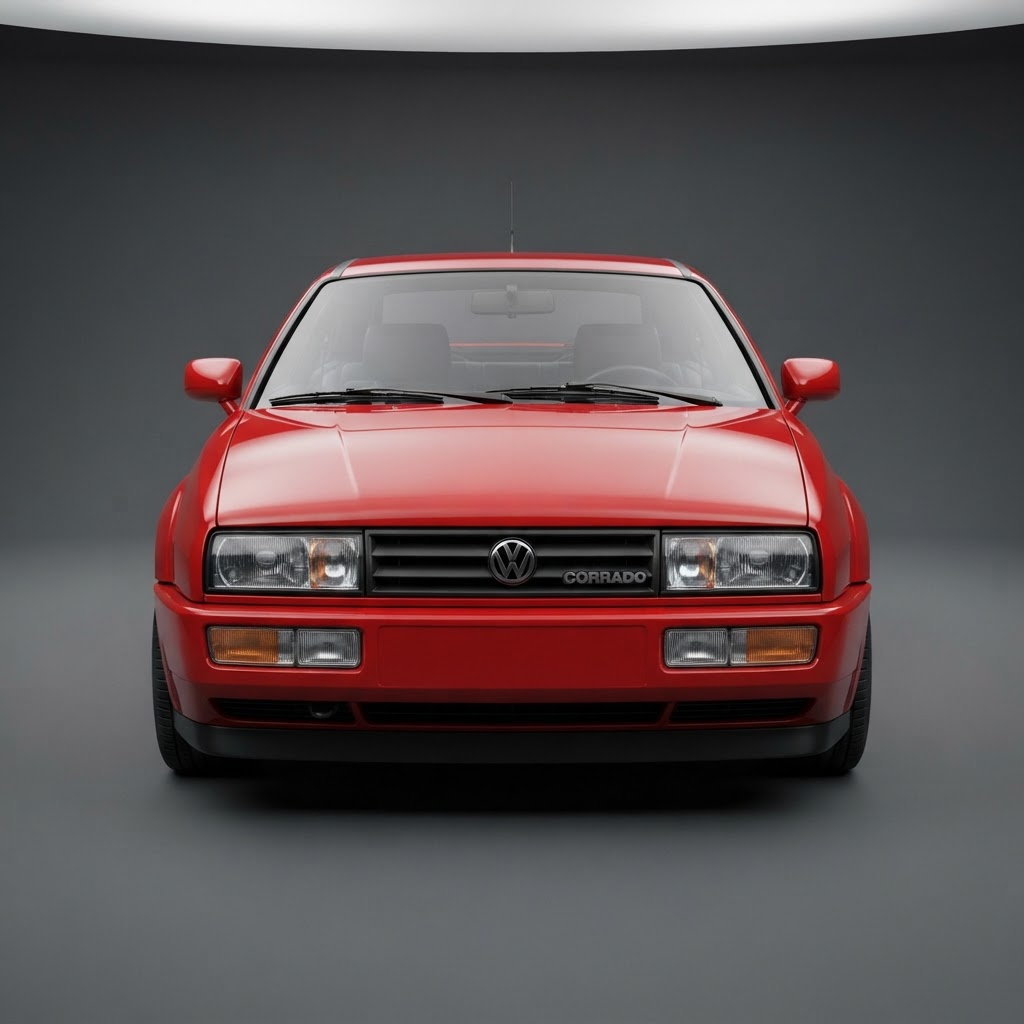
A coupe with a party trick
The Corrado was built by Karmann and sold between 1988 and 1995, and it is remembered for two things: the active rear spoiler that lifts at speed, and the fact that it was the first car to use a VR6. Both matter when you are buying one, because one is a mechanism that fails and the other is an engine that needs care.
It is a proper modern classic now, with values that have moved well past the banger stage. That changes the buying advice: on a cheap example you are buying a project, and on an expensive one you are buying documentation, originality and rust-free metal.
Which engine
The 16v cars (1.8 KR and 2.0 9A, both around 136 PS) are the sensible entry. They are simple, rev happily and the parts are shared with the Golf Mk2 and Mk3. The 2.0 16v is the smoother of the two and slightly more sought after.
The G60 is the odd one. A supercharged 1.8 with 160 PS, a distinctive whine and a supercharger that needs rebuilding roughly every 60,000 miles. That rebuild is the difference between a good G60 and a money pit, and it is the first question to ask any seller.
The 2.9 VR6 (ABV, 190 PS) is the flagship and the one collectors want. It is smooth, sounds extraordinary and has a timing chain arrangement that is expensive to put right. It also has a narrow-angle layout that makes the front end heavy, which is part of the character.
What to check before you buy
- Rust. Sills, rear arches, the windscreen surround, the tailgate and the area behind the plastic side skirts. This is a Karmann-bodied car from the late eighties and water has had decades to work.
- The active rear spoiler. It should rise and fall cleanly. The mechanism, the motor and the microswitches all fail, and a stuck spoiler is both an MOT question and a warning light.
- The sunroof. Cables and guides break, and a leaking sunroof puts water into the headlining and the footwells.
- On the G60, the supercharger. Ask for a rebuild invoice with a mileage. A noisy or weak G60 is a several-thousand-pound problem.
- On the VR6, the timing chain. Listen for a rattle from the gearbox end of the engine on start-up. Chain and guide work requires the gearbox off.
- Electrics. Digifant engine management, the fuse box and the various relays are all of an age where cracked solder joints cause intermittent faults that are hard to trace.
- The heater matrix. A sweet smell and a misting screen mean a dashboard-out job.
Modifying one, carefully
These cars have crossed the line where originality is worth more than modification. If the car is a good, standard example, keep it that way: the market rewards it and the parts you remove are increasingly hard to find.
If you are building a modified car, the sensible route is a modest drop on quality dampers, a set of period-correct 4x100 wheels and a brake upgrade from a later car. Avoid wide arches and huge wheels: they look dated on a Corrado and they destroy the ride on a car with this little suspension travel.
Fitment and running costs
4x100 PCD with a 57.1 mm centre bore, the same as the Golf Mk2 and Mk3. Offsets around 35 to 45 mm work; check the rear arch lip on anything wider than 7.5 inches.
Running costs depend entirely on which engine you choose. The 16v is cheap and simple, the G60 adds a supercharger rebuild to the schedule, and the VR6 adds fuel, chains and front tyre wear. Budget for a specialist: these are not cars to learn on.

